Showing posts with label Assyria. Show all posts

Tuesday, December 6, 2022

RLPB 674. Syria & Iraq: Christian Crisis in Mesopotamia

Religious Liberty Prayer Bulletin | RLPB 674 | Wed 07 Dec 2022
RLPB is published weekly to facilitate strategic intercessory prayer.

Sign up for the RLPB at www.ElizabethKendal.com 
View RLPB archives at Religious Liberty Prayer Bulletin blog.
For bite-size: follow religiouslibertyprayer on Instagram.

SYRIA & IRAQ: CHRISTIAN CRISIS IN MESOPOTAMIA
By Elizabeth Kendal

According to a recent report by the Catholic charity, Aid to the Church in Need (ACN), the number of Christians living in Syria has dropped from 1.5 million or 10 percent of the population before 2011, to roughly 300,000 or two percent of the population today. Most Christians in Syria are ethnic Assyrian (the indigenous nation of the Fertile Crescent), Armenian and Greek. The situation is much the same in Iraq, where the Assyrian population has declined from 1.4 million (1987 census) to about 200,000 in 2016, to maybe as few as 100,000 today. According to Iraqi Cardinal Louis Raphael Sako, Patriarch of Iraq’s Chaldean Church (Nov 2022), half of Iraqi Christians have emigrated in the last five years and many others are ‘on the waiting list’; indeed, they are leaving ‘at a rate of around 20 families a month’. It is an existential crisis about which the West – who, over the course of at least 170 years, has repeatedly betrayed Christians into the hands of Muslims – prefers to remain silent.
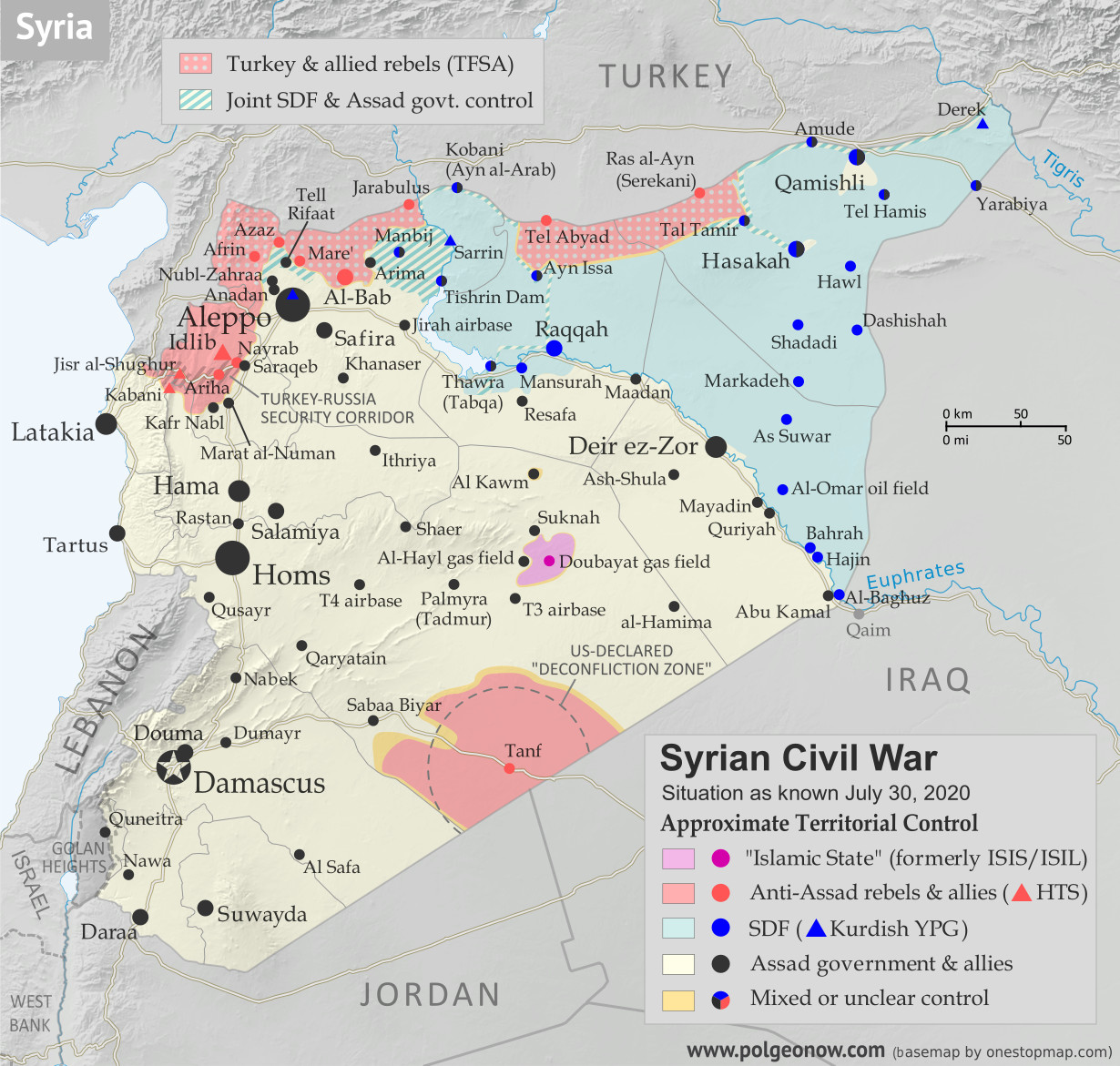
Map source (July 2020)

SYRIA: Most Syrian Christians live with good, albeit fragile, religious security and liberty in government-controlled regions along the north-south Damascus to Aleppo axis, in the Alawite heartland of coastal Latakia, and in the Kurdish-controlled north-east. Very few (if any) Christians remain in Idlib Province in Syria’s far north-west which is controlled by al-Qaeda, infested with jihadists and protected by Turkey.

In government-held areas the greatest threat to the Christian presence is crippling poverty, lack of healthcare and the near total absence of any opportunity to work, rebuild or flourish. This is almost exclusively due to US sanctions, specifically the Caesar Syria Civilian Protection Act which essentially places all government-controlled areas of Syria in a state of economic siege [see RLPB 580, Loving Syria’s Christians, 16 December 2020]. In June 2020 Joseph Tobji, the Maronite Archbishop of Aleppo, lamented that the US government was ‘willing to do anything, even to sacrifice millions of people, poor people, families’ in pursuit of its goals (e.g. regime change in Damascus). As Melkite Archbishop of Aleppo, Georges Masri, recently confirmed (ACN, 7 Nov), it is due to sanctions that many Syrians now die for lack of medication.

Meanwhile, in the Kurdish-dominated north and north-east, the greatest threat comes from Turkish aggression [see RLPB 654 (20 July 2022)]. On 22 and 23 November, Turkish airstrikes on the Al-Hol camp – which holds thousands of Islamic State (IS) fighters and families – killed eight security officers from the Kurdish-led Syrian Democratic Forces (SDF) forces and enabled the escape of an unknown number of IS families. The Syrian Observatory for Human Rights confirmed the incident and spoke of ‘indescribable chaos’ in Al-Hol. Though Turkey is unlikely to launch a large-scale ground invasion deep into Syria’s north-east, it might settle for unleashing IS against the Kurds. The last thing Syria’s remnant Christians need is a return of IS terror. Meanwhile, Turkey might launch a limited ground invasion west of the Euphrates to seize control of Tel Rifaat (40km north of Aleppo) and Mambij in northern Aleppo Governorate – towns (along with Kobane) Turkey has identified as ‘sources of trouble’. The last thing Aleppo’s remnant Christians need is a return of Turkish forces and their murderous jihadist proxies. Lord have mercy!
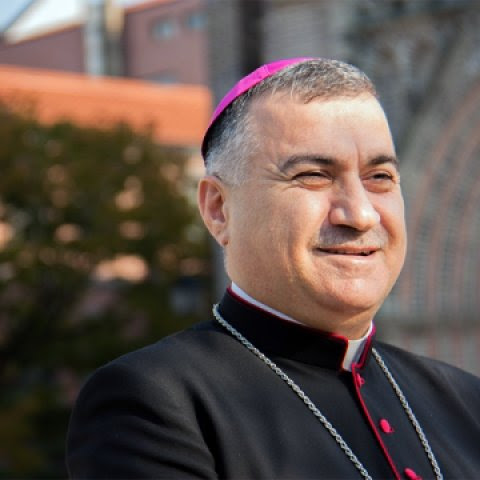
Archbishop Bashar Warda 

IRAQ: In Iraq today most Assyrians live either as refugees in Iraqi Kurdistan or as persecuted believers struggling to rebuild their lives in the historic Assyrian heartland of the Nineveh Plains in Nineveh Province, Northern Iraq. Assyrians who return to the Nineveh Plains face enormous challenges, including political marginalisation and violent persecution from land-grabbing Kurds (Sunnis, backed by the Kurdish administration) and Shabaks (Shi’ites, backed by Baghdad and Tehran) [see RLPB 642 (27 April 2022)]. In August, the Chaldean Patriarch of Baghdad, Cardinal Raphael Louis Sako warned that in the absence of major systemic political, social and economic changes, Christians in Iraq are ‘heading towards disappearance’ [RLPB 660 (31 Aug 2022)]. At the 2-3 November G20 Religion forum (R20) in Bali, Indonesia, Archbishop Bashar Warda of Erbil addressed hundreds of religious leaders. He warned that after 1900 years of existing in the region, ‘we Christians of Iraq now find ourselves on the very edge of extinction’. [For more detail see: RLPB 545, Prayer for Assyria: ‘the Assyrian crisis is our crisis’, 15 Apr 2020.]


PLEASE PRAY THAT OUR MERCIFUL GOD WILL

* protect, sustain, guide and encourage Syria’s suffering and imperilled Christians who, having survived war and remained in their homeland, now find themselves languishing under ‘inhumane’ US sanctions and/or facing the prospect of renewed Islamic terror, foreign invasion and displacement. May the Lord intervene to bring the sanctions to an end. May the Lord intervene to establish peace in Syria. Lord have mercy!

* bless the numerous Christian churches and Christian ministries that are providing services and care to Syria’s poor, sick, hungry, threatened and displaced; may the Lord protect them and supply their every need. Lord have mercy!

* intervene in Iraq to protect, bless and build the Assyrian Church and nation according to his promise: 'The Lord Almighty will bless them, saying, "Blessed be Egypt my people, Assyria, the work of my hands, and Israel my inheritance ' (Isaiah 19:25 ESV) (emphasis mine).


SUMMARY FOR BULLETINS UNABLE TO RUN THE WHOLE ARTICLE
------------------------------------------
SYRIA & IRAQ: CHRISTIAN CRISIS IN MESOPOTAMIA


Most Christians in Syria and Iraq are ethnic Assyrian, Armenian and Greek. With their historic heartland in Nineveh, northern Iraq, the Assyrians are the indigenous people of Mesopotamia. The number of Christians living in Syria has declined from 1.5 million before 2011, to roughly 300,000 today. In Iraq, the Assyrian population has declined from 1.4 million (1987 census) to about 200,000 in 2016, to maybe as few as 100,000 today. In Syria the Christian presence is under threat due to ‘inhumane’ US sanctions, as well as Turkish aggression which risks reviving Islamic terror. In Iraq, the threat comes from crippling ethno-religious discrimination and persecution, and Muslim land-grabbing backed by powerful interests in ‘Kurdistan’, Baghdad and Tehran. Church leaders warn that Christians in Iraq are ‘on the very edge of extinction’. Please pray.

------------------------------------------

Elizabeth Kendal is an international religious liberty analyst and advocate for the persecuted Church. The Religious Liberty Prayer Bulletin (RLPB) is a donor funded ministry; to support this ministry visit www.ElizabethKendal.com .

Elizabeth has authored two books: Turn Back the Battle: Isaiah Speaks to Christians Today (Deror Books, Melbourne, Australia, Dec 2012) which offers a Biblical response to persecution and existential threat; and After Saturday Comes Sunday: Understanding the Christian Crisis in the Middle East (Wipf and Stock, Eugene, OR, USA, June 2016). She is also an Adjunct Research Fellow at the Arthur Jeffery Centre for the Study of Islam at Melbourne School of Theology.

For more information see www.ElizabethKendal.com 

Tuesday, April 14, 2020

RLPB 545. Easter Devotion (3); plus Prayer for Assyria (Iraq)

Religious Liberty Prayer Bulletin | RLPB 545 | Wed 15 Apr 2020
RLPB is published weekly to facilitate strategic intercessory prayer.

Please forward this prayer bulletin widely and encourage others to sign up to the Religious Liberty Prayer Bulletin blog. "The prayer of a righteous person is powerful and effective." (James 5:16 NIV)


EASTER DEVOTION (3); plus PRAYER FOR ASSYRIA
By Elizabeth Kendal

While Catholic and Protestant Churches celebrated Easter over 10-12 April, Orthodox Churches will celebrate Easter this coming weekend, 17-19 April. Different calendars, different histories, different traditions, different understandings, but ultimately 'one flock, one shepherd' (John 10:16).

PRAYER FUEL: ASSURED OF GOD'S LOVE

Through Isaiah's 'servant songs', God's Servant - once hidden, as if behind a curtain - is gradually, progressively revealed. With each servant song the curtain is opened a little wider, so we might see more and learn more. The first servant song reveals God's Servant to be a chosen, quiet, resolute and compassionate healer and deliverer who will establish justice on the earth (Isaiah 42:1-9). The second servant song (49:1-7) sharpens the focus while expanding our view, adding that God will make his Servant - whose mouth, though quiet (42:2), is like a sharpened sword (49:2) - 'as a light for the nations, that my salvation may reach to the end of the earth.' Wow! Consequently, we are shocked to discover that, far from being a national hero, God's Servant is 'deeply despised, abhorred by the nation' (v7) [RLPB 543 (1 April)]. The third servant song (50:4-9) opens the curtain wider still, revealing the Servant to be a faithful disciple and 'wonderful counsellor' (Isaiah 9:6), an obedient disciple who says 'Not my will but thine' (Luke 22:42) and submits to abuse and torture (v6), confident that God will both help and vindicate him … which he does. Consequently, now it is his adversaries who are defenceless, helpless in the face of the truth [RLPB 544 (8 April)].

The fourth servant song (Isaiah 52:13 - 53:12) is a poem comprising five stanzas of three lines each, structured as follows: A B(1) B(2) B(3) A. In the opening and closing stanzas (the two As) God makes declarations concerning his Servant, building again on what we have already learned. The three central stanzas (the three Bs; Isaiah 53:1-9) reveal in greater detail what God's Servant suffers. At the pinnacle of the poem, in verses 4 - 6, we are drawn to look not merely at the scene but through it, into the very heart of God, as we finally learn why God's Servant suffers. He suffers that he might bear our griefs and carry our sorrows, he is pierced for our transgressions, crushed for our iniquities, chastised for our peace and wounded for our healing. Though we all rebelled and turned away, he - in amazing grace - surrenders his life to redeem us all.

Dear believer, are you suffering? Are you afraid, anxious, confused? Do your trials make you wonder if God really loves you? Read aloud this servant song - insert yourself into verses 4-6 - and hear God speak: 'This is how much I love you!' So, dear intercessor - brother, sister - pray with confidence, fully convinced that the one who rules over heaven and earth not only sees and hears you, but loves you with a love already demonstrated and proven on the cross (Romans 5:8 ESV); a love so immeasurably wide and long and high and deep that it surpasses knowledge (Ephesians 3:18,19); a love from which you can never be separated (Romans 8:31-39). God has desired you; Christ has redeemed you, and the Spirit has sealed you. So draw near to him and pray! 'Arise, cry out in the night ... pour out your heart like water ... lift your hands to him' (Lamentations 2:19) and watch (צָפָה tsâphâh) expectantly (Psalm 5:1-3).

All four studies (pdf): Prayer Fuel from the Servant Songs of Isaiah

-------------------------------------------

IRAQ: ASSYRIAN CRISIS IS OUR CRISIS

Iraq Control Map - January 2020
Political Geography Now
Four times in the last year Religious Liberty Prayer Bulletin (RLPB) warned that an existential Christian crisis persists in Iraq. In June 2014, Islamic State (then known as ISIS) seized Mosul, the capital of northern Iraq's Nineveh/Ninawa Province, in a blitzkrieg. In August 2014, after consolidating in Mosul, IS ethnically cleansed the Nineveh Plains, the historic heartland of Iraq's indigenous Assyrian nation. When Mosul was liberated in July 2017, displaced Assyrian Christians began trickling back into the Nineveh Plains, eager to rebuild and re-establish themselves as a Christian nation within Iraq. However, not only are Kurds (Sunnis) and Shabaks (Shi'ites, backed by Baghdad and Tehran), devouring and colonising Assyrian lands, but Islamic State (hyper-intolerant, anti-Shi'ite Sunnis, backed by Turkey) has been re-grouping in the desert and in the Hamrin Mountains, preparing for a come-back. With so much against them and so little international support for them, Assyrian Christians are starting to wonder if their vision of re-establishing their Christian nation in the Nineveh Plains is nothing but a mirage [RLPB 541 (18 Mar 2020)].

In recent months, several coalition members - including France and Britain - have withdrawn their troops and halted their training programs because of the COVID-19 pandemic. In mid-March, after engaging in a series of deadly tit-for-tat missile strikes with Iran-backed Shi'ite militias, the US opted to reposition its troops, leaving some bases while consolidating in others. However, pressure is mounting in Washington and Baghdad for a complete US withdrawal lest Iraq become the battlefield for a US-Iran proxy war. According to the US narrative, the war against Islamic State is over and Iraqi troops have been trained to deal with anything that might arise. Yet, according to most independent analysts, the Iraqi Army will struggle to contain a revived Islamic State without the air support and intelligence gathering that US and coalition forces provided.

Furthermore, the COVID-19 pandemic and plummeting oil prices have pushed Iraq's economy to the brink of collapse. The crisis will provide Islamic State with a perfect opportunity to advance its agenda. It is looking more likely that conflict could erupt between Islamic State (Sunnis, backed by Turkey) and Shi'ite troops and militias (backed by Baghdad and Tehran). Turkey has long desired unobstructed access to the vilayet/province of Mosul (formerly part of the Ottoman Empire). Similarly, throughout its history, Persia has desired unobstructed access to the Mediterranean. Meanwhile, everyone desires oil-rich Kirkuk! On 11 April, Islamic State claimed responsibility for a bombing in Kirkuk that killed two Peshmerga fighters (Kurdish military).

Assyrian Christians desperately need our prayers; their crisis is our crisis! Praise God, Christ is faithful: 'A bruised reed he will not break, and a faintly burning wick he will not quench; he will faithfully bring forth justice' (Isaiah 42:3) and his salvation will reach to the end of the earth (Isaiah 49:6). As for Christ's adversaries, their days are numbered (Isaiah 50:9). All believers should pray in faith, with the energy that comes from hope, and assured of God's love (Isaiah 53:4-6) which remains forever true regardless of circumstances.


PLEASE PRAY THAT OUR ALMIGHTY GOD WILL

* intervene in Iraq to protect, bless and re-establish the Assyrian Church and nation according to his promise: 'The Lord Almighty will bless them, saying, "Blessed be Egypt my people, Assyria my handiwork, and Israel my inheritance ' (Isaiah 19:25 NIV, emphasis mine).

* intervene internationally for the benefit of his people; may nations that have the ability - and even a responsibility - to assist the Assyrian people be roused to advocacy and action on their behalf; and may Christians around the world embrace their calling to love and pray for their gravely imperilled brothers and sisters that the battle might be turned back at the gate (Isaiah 28:5-6).

'Is not this the fast that I choose: to loose the bonds of wickedness ... and not to hide yourself from your own flesh?' (from Isaiah 58)


SUMMARY FOR BULLETINS UNABLE TO RUN THE WHOLE ARTICLE
------------------------------------------------------------
ASSYRIAN CRISIS IN IRAQ IS OUR CRISIS

Assyrian Christians in northern Iraq desperately need our prayers. Multitudes remain in cramped camps, highly vulnerable to COVID-19. Meanwhile, the hopes of those who have dared to return to the Nineveh Plains (the historic Assyrian heartland) are fading fast as Kurds and Shabaks steal their lands and as Islamic State threatens a comeback. Britain and France have withdrawn their troops and the US might not be far behind. Meanwhile, the COVID-19 pandemic and plummeting oil prices have pushed Iraq's economy to the brink of collapse. The crisis is providing Islamic State with an opportunity to advance its agenda. A clash between Islamic State (backed by Turkey) and Shi'ite troops and militias (backed by Baghdad and Tehran) seems inevitable. Iraq's Christian crisis could soon get much worse. Please pray.

------------------------------------------------------------
Ramadan commences 23-24 April
RLPB recommends: 30 Days of Prayer for the Muslim World
https://www.30daysprayer.com/
------------------------------------------------------------

Elizabeth Kendal is an international religious liberty analyst and advocate. She serves as Director of Advocacy at Canberra-based Christian Faith and Freedom (CFF) and is an Adjunct Research Fellow at the Arthur Jeffery Centre for the Study of Islam at Melbourne School of Theology.

She has authored two books: Turn Back the Battle: Isaiah Speaks to Christians Today (Deror Books, Melbourne, Australia, Dec 2012) which offers a Biblical response to persecution and existential threat; and After Saturday Comes Sunday: Understanding the Christian Crisis in the Middle East (Wipf and Stock, Eugene, OR, USA, June 2016).

See www.ElizabethKendal.com 

Tuesday, March 12, 2019

RLPB 493. Iraq: from Nation to Decimation to Elimination

Religious Liberty Prayer Bulletin | RLPB 493 | Wed 13 Mar 2019
RLPB is published weekly to facilitate strategic intercessory prayer.

Please forward this prayer bulletin widely, and encourage others to sign up to the Religious Liberty Prayer Bulletin blog. "The prayer of a righteous person is powerful and effective." (James 5:16 NIV)

IRAQ: FROM NATION TO DECIMATION TO ELIMINATION
-- the plight of Iraq's indigenous and Christian Assyrian nation
-- by Elizabeth Kendal

Islamic State (IS/ISIS) is making a come-back in Iraq. Military analyst David Kilcullen remarks that with its resurgence, IS is 'giving new meaning to its motto "Remaining and ¬Expanding".' While IS attacks are presently small scale and low intensity -- comprising mostly bombings, raids, assassinations and sectarian executions -- they are increasing in frequency and sophistication. According to the Institute for the Study of War (ISW), IS maintains some 30,000 fighters in Iraq and Syria, of whom up to 17,000 are in Iraq, including 1,000 who have crossed over from Syria in the past six months.  ISW reports that IS is re-establishing zones of support, lines of supply and the means to generate revenue (mostly through drugs and extortion). As long as Baghdad remains enmeshed in political power struggles between parties that are proxies of either Iran or America, IS will exploit the paralysis to re-establish itself across Iraq.

In January the Prime Minister of the Kurdistan Regional Government, Nechirvan Barzani, ominously warned, 'We have concerns about the return of IS ... to Nineveh [Province, northern Iraq].' On 20 February the Iraqi Army's Chief of Staff Othman al-Ghanimi told reporters at a press conference near Mosul that Iraqi security forces had detained 24 IS militants. The group, which had escaped Syria and was headed for Mosul, included four IS leaders. Later that day, Iraqi security and intelligence forces intercepted a car near Badush, 25km north-west of Mosul, killing the five IS fighters inside, each of whom was reportedly wearing an explosive vest. On 28 February IS successfully carried out a car-bomb attack in Mosul, killing one civilian and wounding 13. On the same day, a car-bomb exploded near Mosul University, killing two and wounding 24. On Friday 8 March a car-bomb in Mosul killed two (including a child) and wounded 10. It must be noted that, whilst violence has escalated, not all recent bombings have been claimed by IS.

The return of IS is not the only threat facing Nineveh's already decimated indigenous and Christian Assyrian remnant. In August 2014, as IS advanced east from Mosul towards oil-rich Kirkuk, the jihadists overran and ethnically cleansed the Nineveh Plain, displacing around 130,000 Assyrian Christians, along with other non-Sunni minorities, including the Shabak. Possibly with Persian roots, the Shabak follow a syncretistic form of Shia Islam. Today, it seems that Baghdad and Tehran are using the Shabak as a proxy as they struggle against the Kurds for control over Nineveh's 'Disputed Territories', which includes the Assyrian heartland. If there is one thing the Kurds, the Shabaks, Baghdad and Tehran all agree on, it is their desire to eliminate the Christian presence and even erase millennia of Assyrian and Christian history.

Cross over Bartella
click here for Video (by Rudaw, 11 Feb 2019)

Ground zero in this existential struggle is the Assyrian town of Bartella, 21km due east of Mosul. Prior to August 2014, Bartella had been policed by the mostly Christian, Assyrian Ninewa Protection Unit (NPU). Today, security in the area is controlled by Iraq's mostly-Shia, Popular Mobilisation Force (PMF), also known as 'Hashd'. In Bartella, the Hashd are mostly Shabak. Of the 3,800 Christian families to have fled Bartella in 2014, less than one third have returned. In Bartella they face not just devastation, but disturbing levels of harassment, intimidation and threat. Christian leaders are convinced that the Shabak are working to drive them away, prevent their return and replace them with Shabak Shi'ites. To this end they have the backing of Baghdad and Tehran. Regional authorities are establishing new settlements in Bartella with the aim of repopulating the town. One project under way in an area traditionally occupied by Assyrian Christians is named 'Sultan City'. The project involves seizing agricultural land owned by Assyrians and converting it into a residential area with hundreds of new homes. The project was first outlined in 2013, but had to be postponed due to the ISIS occupation.  This situation is being repeated, albeit to a lesser extent, in the nearby Assyrian towns of Karamles and Qaraqosh/Bakhdida.

Interview with Father Behnam Benoka
As Father Behnem Benoka notes: IS are Sunnis and the Shabak are Shi'ite, 'but all are Muslims. Everybody hates the Church, everybody hates Christians and wants them out of their historical places.'

PLEASE PRAY SPECIFICALLY THAT GOD WILL 

* intervene in Iraq to the benefit of his Church and the long-suffering, severely persecuted Assyrian remnant (see, Isaiah 19:23-25):
-- may historic Assyrian/Christian towns be officially recognised and protected,
-- may the campaign to alter the demography of the Nineveh Plain be stopped, and
-- may the indigenous Assyrians be granted the right to govern and police themselves.

* bless and sustain Iraq's pastors, priests, nuns and other Christian workers as they risk their lives and struggle against overwhelming odds to rebuild and maintain the Christian presence in Iraq; may spiritual unity blossom across ethnic and denominational lines.

The Lord Almighty will bless them, saying, “Blessed be Egypt my people, Assyria my handiwork, and Israel my inheritance.” (Isaiah 19:25 NIV)

* bless and sustain his precious Church across Mesopotamia (Syria-Iraq / the Fertile Crescent); may the Lord bring physical, emotional and spiritual healing to all who have been profoundly shattered, fundamentally distracted and spiritually challenged by violence, displacement and betrayal.


SUMMARY FOR BULLETINS UNABLE TO RUN THE WHOLE ARTICLE 
-------------------------------------------------------------
IRAQ: FROM NATION TO DECIMATION TO ELIMINATION

Some 17,000 Islamic State (IS/ISIS) fighters are believed to be consolidating in Iraq, where IS attacks are increasing in frequency and sophistication. But their return is not the only threat facing Iraq's remnant Christians, most of whom belong to the long-persecuted Assyrian nation, whose historic heartland is in northern Iraq's Nineveh Plain. Baghdad and Tehran are currently struggling against the Kurds for control of the north's 'Disputed Territories', which includes the Assyrian heartland. To that end, Baghdad and Tehran are apparently using the Shabak -- a distinct ethnic group who are nominally Shi'ite -- as their proxy against the Kurds in Nineveh. The Shabak are working to seize Assyrian lands, drive the Christians out, prevent their return and replace them with Shabak, seemingly with Baghdad's approval. Please pray for Iraq's Christians.

-------------------------------------------------------------

Elizabeth Kendal is an international religious liberty analyst and advocate. She serves as Director of Advocacy at Canberra-based Christian Faith and Freedom (CFF), and is an Adjunct Research Fellow at the Arthur Jeffery Centre for the Study of Islam at Melbourne School of Theology.

She has authored two books: Turn Back the Battle: Isaiah Speaks to Christians Today (Deror Books, Melbourne, Australia, Dec 2012) which offers a Biblical response to persecution and existential threat; and After Saturday Comes Sunday: Understanding the Christian Crisis in the Middle East (Wipf and Stock, Eugene, OR, USA, June 2016).

See www.ElizabethKendal.com 

Tuesday, October 13, 2015

RLPB 331. Syria: Plight of Assyrian Captives

Religious Liberty Prayer Bulletin | RLPB 331 | Wed 14 Oct 2015

----------------------------------------------
Supporting International Day of Prayer (IDOP)
   for the Persecuted Church
IDOP 2015: Sunday 1 or 8 November
   See Critical Prayer Requests (CPR)
-----------------------------------------------

SYRIA: PLIGHT OF ASSYRIAN CAPTIVES
plus: Egypt and Bangladesh 
By Elizabeth Kendal

HASAKAH: On 23 February 2015 Islamic State (IS) jihadists conducted a pre-dawn raid on 35 Assyrian Christian villages along a 40km stretch of the Khabour River in Syria's north-eastern Hasakah Province. As some 3000 Assyrian Christians fled into the darkness, 253 were taken captive. [See RLPB 298 (25 Feb 2015)] Around 40 elderly and frail captives were subsequently released but the remainder, including women and children, have been in IS captivity ever since.

VIDEO 1: On 7 October IS released a video showing the execution of three Assyrian captives from Hasakah. The execution is dated 23 September 2015, Eid al-Adha (the Muslim 'Feast of Sacrifice').

source: AINA
The video shows three Assyrian men dressed in orange jumpsuits, kneeling before the camera. One by one the Assyrians introduce themselves: 'I am Christian Assyrian ...' followed by their name, date of birth and home village. Three jihadists then assume their positions, draw their handguns and shoot the Christian men through the back of the head. As the Assyrians fall forward dead, three more Assyrian men dressed in orange jumpsuits come into the frame. Kneeling between their dead Assyrian brothers and their executioners, these men introduce themselves in the same way: 'I am Christian Assyrian ...' followed by name, date of birth and home village. 'We are here and there are dozens of us,' says the third Assyrian. 'Our fate is the same as these,' he says as he points to the dead. 'If you do not take proper procedure for our release [pay the ransom estimated at $10 million] we realise the inevitable fate.'

HOMS: On 21 May 2015, soon after capturing UNESCO world heritage-listed Palmyra in Syria's central Homs Province, IS forces made an incursion into nearby Qaryatayn, kidnapping Jesuit priest Father Jacques Mourad and his companion, a deacon named Boutros. The men had been caring for hundreds of refugees in Qaryatayn's Mar Elian Monastery. [See RLPB 311 (27 May)] On Thursday 6 August 2015 IS captured Qaryatayn, taking some 230 residents captive, including around 150 Syrian Christians whose names were on an IS list of 'wanted' government supporters. [RLPB 322 (12 Aug)] IS has since demolished the fifth century Mar Elian Monastery. [RLPB 324 (26 Aug)]

VIDEO 2: IS has now released a video of its conquest of Qaryatayn. Entitled 'Fight until they pay the jizya pledging subservience to Muslim rule' ( a reference to Qur'an, Sura 9:29), the video shows the destruction of crosses and a meeting in which a group of Christians sign a dhimma contract.

Video - in Arabic
The contract stipulates that the Muslims are not to harm the Christians who secure right to life as second-class citizens, provided they submit to Islamic rule. The Christians must also comply with a list of classic Islamic demands including: they must pay jizya (protection money); refrain from public expressions of Christianity; respect all Muslims and never criticise Islam. The alternatives are conversion to Islam or death. Sources told Middle East Concern that Assyrian Christian Fahid Khazaal was martyred for his refusal to convert or submit. Visible among the Christians signing the dhimma contract is Father Jacques Mourad, although he was subsequently released in good health on 10 October. The circumstances of his release are unclear. The Christians seen signing the contract are doubtless the 'wanted' government supporters taken captive in May. Consequently, it is possible that IS already has plans to make examples of them. Lord have mercy!

PLEASE PRAY SPECIFICALLY FOR

* the Assyrian captives -- some 200 from Hasakah and around 150 in Qaryatayn; may they fix their eyes on Jesus, the founder and perfecter of their faith (Hebrews 12:2 ESV). May they know the powerful and glorious presence (Hebrew: miqdas, 'sanctuary') of the Lord as they walk by faith, think spiritually and fear only him [Isaiah 8:11-14; see chapter 3 in Turn Back the Battle].

'The LORD is my portion,' says my soul, 'therefore I will hope in him.' (Lamentations 3:24 ESV)

* the Lord of Hosts to rise up and burst through his enemies (2 Samuel 5:17-25), intervening for his people's deliverance. 

* the imperilled Assyrian remnant scattered throughout Syria and Iraq, displaced Assyrians in Iraqi Kurdistan and the refugees in southern Turkey, Jordan, Lebanon and the migrant centres of Europe; may the Lord protect and preserve them ahead of that promised day when he restores them to their land: 'Assyria the work of my hands.' (Isaiah 19:25).

~ ~ ~ ~

SUMMARY FOR BULLETINS UNABLE TO RUN WHOLE ARTICLE
------------------------------------------------------------
THE PLIGHT OF ASSYRIAN CAPTIVES IN SYRIA


Islamic State (IS) has released two new videos. The first shows three Assyrian Christian men from  more than 200 taken captive in north-eastern Hasakah Province in February. After these three are executed, three more appear and kneel behind the dead. They confirm IS is holding 'dozens of us' who will be killed if ransom (estimated at $10 million) is not paid. The second video shows Assyrian Christians taken captive during the August conquest of Qaryatayn in central Homs Province. They are signing a dhimma contract guaranteeing the Christians' right to life as second-class citizens, provided they pay jizya (protection money) and submit to Islam -- refraining from public Christianity, respecting Muslims and Islam. Fahid Khazaal was martyred for refusing to convert or submit. Please pray for Assyrian Christians and for Syria.

------------------------------------------------------------
Also --

EGYPT: Officials raided the Egypt office of Christian satellite TV broadcaster SAT-7 on 10 October, seizing cameras, computers and other equipment. Office Director Mr Farid Samir was questioned in the police station for over six hours. The charges against the office are baseless as all SAT-7's registration and licences are in good order. The Prosecutor must now determine whether the case should proceed to trial. This could take up to two weeks. Please pray for this vital ministry. 

BANGLADESH UPDATE: Just hours after last week's Prayer Bulletin on Bangladesh was posted, news emerged that a Bangladeshi pastor had just survived an attempted beheading thanks to courageous family members and neighbours who fought off the attackers. Though the injuries to Rev Luke Sarker's neck required stitching, they are not life-threatening. The Lord is merciful. Please cover Bangladesh in prayer.

---------------------------------------------------------------


Elizabeth Kendal is the author of
Turn Back the Battle: Isaiah Speaks to Christians Today
(Deror Books, Dec 2012).
http://www.turnbackthebattle.com/thebook.html

Her second book, ‘After Saturday Comes Sunday’: Understanding the Christian Crisis in the Middle East, will be published by Wipf and Stock (Eugene, OR, USA) in early 2016.

Wednesday, September 9, 2015

RLPB 326. Christian Crisis in the Middle East

Religious Liberty Prayer Bulletin | RLPB 326 | Wed 09 Sep 2015

CHRISTIAN CRISIS IN THE MIDDLE EAST
By Elizabeth Kendal

In any conflict, explains Australian author Denis Dragovic, the wealthy are the first to flee. Then, as life becomes intolerable, the middle class flee across borders into camps where they wait in hope that the fighting will end and they will be able to return to their homes and businesses. When the fighting doesn't end, they seek alternatives, including the services of people smugglers. 'In the case of Syria ... ,' says Dragovic, 'we are now in that last phase.' Lacking resources, the poor have little choice but to stay and watch their children grow up traumatised, brutalised and without stable education. When peace comes, says Dragovic, the fighters are rewarded with top jobs while the traumatised poor have little to offer, making reconstruction virtually impossible. At this point the protagonists -- neo-Ottoman Turkey, Saudi Arabia, Iran, al-Qaeda and ISIS -- will doubtless fight to fill the void.

Like many analysts, Dragovic maintains that a more sustainable solution is to 'better resource the front-line countries, Turkey, Lebanon and Jordan, while putting pressure on Saudi Arabia and the Gulf states to accept asylum applications'.

[Despite fuelling the conflict, Saudi Arabia and the Gulf Arab states have taken in ZERO Syrian (Arab Sunni Muslim) refugees.]

political cartoon by Carlos Latuff
A Europe struggling with demographic decline might hope to benefit from an influx of skilled migrants. However, the mass inflow of an alien culture brings with it huge risks. Parallel societies will consolidate and racial-religious tensions will escalate. This will most certainly end badly. Muslims (generally) are aware of Muhammad's alleged prophesy that Islam would first conquer Constantinople, the capital of eastern/Byzantine Europe, (which it did in 1453) and then Rome (the capital of western/Latin Europe). Islamic fundamentalist ideologues and militants are certainly aware of it and doubtless are deliberately hastening it.

Australia has promised to take more refugees, specifically family groups belonging to 'persecuted minorities in camps'. On one hand, it is very exciting to hear it finally acknowledged that Christians are facing an existential threat. Muslim, human rights and Opposition groups are rejecting the policy as 'discriminatory', which is untenable as Arab Muslims are clearly not facing elimination. The policy is needs-based. On the other hand, the Australian and UK commitment to only take refugees from camps is problematic, for, as Lord Carey recently pointed out, the Christians are generally not in the camps. This has long been the case -- the camps are simply too dangerous for religious minorities. Consequently Christians seek refuge in monasteries, churches and Christian schools. From there, most either share rental properties or are billeted out to local Christian families. Thus the local church carries the burden, not the UN. The global Church needs to share this load and send aid to the churches that are caring for refugees, but only through recognised Christian agencies.

Whilst multitudes of Christian youths and families are understandably desperate to leave the Middle East, their pastors and priests are understandably desperate for them to stay. 'The almost communal wave of youth emigration, especially in Syria, but also in Lebanon and Iraq breaks my heart, wounding me deeply and dealing me a deadly blow,' laments Melkite Greek Catholic Patriarch Gregorios III. 'Given this tsunami of emigration ... what future is left for the Church? What will become of our homeland? What will become of our parishes and institutions?' he asks as he appeals to Christians to stay. Many Christian leaders believe the temptation to flee must be resisted, as the Christian exodus only serves to facilitate the Islamic agenda of a total religious cleansing of the Middle East. But Christians will only stay if they are secure.

In Syria, Christians are only secure in the 20 percent of the country still under government control. Instead of taking directions from regional powers Turkey, Saudi Arabia and Iran -- all state sponsors of terror -- the West should prioritise protecting minorities and working in their interests, so that Christians might be safe in Christianity's historic heartland. To do that, the West might need to swallow its pride and talk to Assad and to Russia. Ever since the Crimean War (in the 1850s) the Islamic powers of the Middle East have exploited their geo-strategic position and played the West off against the East to advance their own ends. Ever since the Crimean War the West has backed Muslims at the expense of persecuted Christians. Surely the time has come for the West to be astute, identify the real enemy and put an end to this ruse, for the sake of imperilled Christians.

The Christian crisis in the Middle East is existential. Of course Christian families should be rescued, but the greatest need of all is for a safe haven in the Middle East where Christians can preserve their heritage and culture and worship freely while educating their children in liberty and security. Around the time of World War One, as the Ottoman Empire unravelled, Assyrians sought to establish an independent free Assyria. [This story is now being told through the film, 'A Man Before his Time: The Unsung Story of Freydun Atouraya.'] More recently the appeal has been for an autonomous region in the ancient Assyrian homeland of the Nineveh Plain. Each appeal has triggered a massacre and today most Western politicians dismiss the prospect of an autonomous Assyrian province in northern Iraq as impossible. But the Assyrian hope lives on, fuelled by faith and rooted in the promise of God as found in Isaiah 19:23-25. As God is faithful, it will come to pass! And in that day, the Lord of hosts will say, 'Blessed be Egypt my people, and Assyria the work of my hands, and Israel my inheritance' (v25 ESV).


PLEASE PRAY SPECIFICALLY THAT

* the Lord of Hosts will intervene on behalf of each imperilled believer in the Middle East -- may those requiring rescue be rescued and those who want to stay in their homeland have sanctuary.

* God will intervene personally on behalf of each monastery and church sheltering and caring for Christian refugees; may the Lord raise all the necessary funds and give a voice to the voiceless.

* the Lord Almighty will secure justice and liberty for his precious people and the Lord of Hosts be their defence.

* the Holy Spirit will flood the hearts of all pastors, priests and Christian religious workers across the Middle East that they will know his love, grace and comfort; may their faith remain strong and their hope not fade; may the Lord bless them for their faithful service.

* our faithful God will intervene to establish 'the work of [his] hands' -- an autonomous Assyrian province in northern Iraq. And may all the glory go to him.


SUMMARY FOR BULLETINS UNABLE TO RUN WHOLE ARTICLE
------------------------------------------------------------
CHRISTIAN CRISIS IN THE MIDDLE EAST

A mass migration is under way as Syrians stream into Europe via Turkey. This is lessening Syria's prospects for reconstruction and is devastating its Church. Whilst multitudes of Christian youths and families are understandably desperate to leave the Middle East, their pastors and priests are understandably desperate for them to stay -- something they will not do without security. While some Christian families do need to be rescued, it is critical that a safe haven be established in the historic Christian heartland. Assyrians have sought this since World War One. Though most Western politicians dismiss this as impossible, the Assyrian hope lives on, fuelled by faith and rooted in the promise of God as found in Isaiah 19:23-25. May Christ intervene for his people and build his Church.

------------------------------------------------------------

Elizabeth Kendal is the author of
Turn Back the Battle: Isaiah Speaks to Christians Today
(Deror Books, Dec 2012).

Her second book, 'After Saturday Comes Sunday: Understanding the Christian Crisis in the Middle East,' will be published by Resource Publications (an imprint of Wipf and Stock, Eugene, OR, USA) in early-mid 2016.