Tuesday, February 21, 2023

RLPB 681. February Update incl. Nigeria, Artsakh, USA, D.R.Congo, Ghana, India, Nicaragua, Pakistan, Sudan

Religious Liberty Prayer Bulletin | RLPB 681 | Wed 22 Feb 2023
RLPB is published weekly to facilitate strategic intercessory prayer.

Sign up for the RLPB at www.ElizabethKendal.com
View RLPB archives at Religious Liberty Prayer Bulletin blog.
For bite-size: follow religiouslibertyprayer on Instagram.

FEBRUARY 2023 UPDATE & ROUNDUP
By Elizabeth Kendal

DURING FEBRUARY WE PRAYED CONCERNING

NIGERIA’S PRESIDENTIAL ELECTION


This Saturday, 25 February, Nigeria’s presidential election will be held amidst soaring ethno-religious tensions, gross insecurity and the threat of widespread election-related violence. Nigeria has a population of 220 million, around half of whom identify as Christian. Those most at risk are minority Christians in the Muslim North and all ethnic Igbo living outside the South East. [The Igbo are Nigeria’s most Christian (98 percent), most industrious and most widely dispersed tribe.] The Nigerian Church is one of the world’s leading missionary-sending Churches.

‘Finally, be strong in the Lord and in the strength of his might. Put on the whole armour of God, that you may be able to stand against the schemes of the devil. For we do not wrestle against flesh and blood, but against the rulers, against the authorities, against the cosmic powers over this present darkness, against the spiritual forces of evil in the heavenly places. Therefore, take up the whole armour of God [described in vs13-17] … [and] keep alert with all perseverance, making supplication [earnest prayer] for all the saints.’ (From Ephesians 6:10-18 ESV)

RLPB 678. Nigerian Elections (1): The Candidates, 1 Feb 2023
RLPB 679. Nigerian Elections (2): Insecurity and the Igbo, 8 Feb 2023
RLPB 680. Nigerian Elections (3): Buhari’s Legacy, 15 Feb 2023

UPDATE: A Redfield & Wilton Strategies poll conducted over 10-12 February showed Labour’s Peter Obi – an ethnic Igbo Christian from the long-marginalised South East – well out in front. Excerpts from the R&WS poll results: ‘Peter Obi (Labour Party) 62 percent; Bola Tinubu (All Progressives Congress) 22 percent; Atiku Abubakar (Peoples Democratic Party) 12 percent; Rubi’u Musa Kwankwaso (New Nigeria People’s Party) 3 percent; another candidate, 1 percent. … While enthusiasm for Obi is said to be driven by younger voters, majorities of voters across all age groups say they intend to vote for Obi. … Peter Obi is the only major candidate in the upcoming election who is viewed favourably by a majority of Nigerian voters…’

However, Peter Obi’s campaign has not been without its challenges. In recent weeks several of the Labour Party’s Northern Muslim gubernatorial and state assembly candidates have abandoned Obi and Labour and defected to the APC and PDP, both of which are running Muslim candidates. The defecting candidates accuse Obi of running a ‘non-inclusive’ campaign and pandering to the Igbo, something his campaign and his supporters deny. Ndi Kato, a spokesperson for Obi’s campaign, told The Africa Report (15 Feb) that she does not believe the high-level political defections will have any impact on the polls. ‘Our foot soldiers are the people of Nigeria. They are volunteering … this election is between the people and the political class.’

Kato’s analysis hits the target! This is an election between the people (i.e. those who have been impoverished) and Nigeria’s political and military elites (i.e. those who profit from systemic corruption). However, it will also be fought between those advancing ethnic (e.g. Fulani) and/or Islamic hegemony, and those demanding religious freedom and tolerance, education and jobs, health, peace and prosperity in a ‘New Nigeria’. The battle is about to begin!

Nigeria is entering a very challenging and indeed pivotal period of its history. Please, keep alert and pray.

ROUNDUP: ALSO IN FEBRUARY

* AZERBAIJAN: ARMENIANS FACE ETHNIC CLEANSING

Armenians under siege.
Photos by Ani Balayan,
Armenian Weekly 15 Feb 2023

Artsakh (Nagorno-Karabakh) – an ethnic-Armenian Christian enclave in Turkic Muslim Azerbaijan – has been in a state of siege since 12 December when Azerbaijani agents blockaded the Lachin Corridor (the road that links Artsakh to Armenia). On 15 February the Armenian Weekly warned: ‘It is beyond any doubt that the actions’ of these Azerbaijani agents ‘serve as a consistent tool for Azerbaijan’s hybrid warfare tactics and systematic policy of ethnic cleansing of Armenians in Artsakh. … Cut off from the outside world, the 120,000-strong population of Artsakh is inching closer to an inevitable humanitarian catastrophe every single day. There are extreme shortages of food, medicine and other basic necessities. There is a lack of proper heating in harsh winter conditions.’ Rich in ancient Armenian Christian architecture (which Azerbaijan doesn’t want), Artsakh is also rich in minerals, in particular gold and copper. Complicating matters, Baku – Azerbaijan’s capital, located on the shore of the Caspian Sea – is rich in oil and gas. That gas – which is desperately needed in Europe – is now flowing through the Southern Gas Corridor. Consequently, we should not expect any Western government will challenge Baku – at least not with anything more than a few meaningless words! The situation is dire. Please pray.

‘It is better to take refuge in the Lord than to trust in princes’ (Psalm 118:9 ESV).
Prayer for Artsakh – Psalm 118:5-17

Recommended: ‘Do you know what is happening in Armenia?’ by Craig Simonian, World Evangelical Alliance’s Peace & Reconciliation Network (PRN), 13 Feb 2023.

MEANWHILE: ARMENIANS IN BEVERLEY HILLS

Flyers posted around Beverly Hills,
28 Jan 2023.

On Saturday 28 January police in Beverly Hills, California, USA, declared that flyers inciting a new Armenian genocide ‘fall within the protection of the First Amendment of the US Constitution’ (i.e. they are protected as free speech). The flyers, which read – ‘Azerbaijan + Turkey + Pakistan + Israel = 4 BROTHERS WILL WIPE Armenia OFF the MAP, Inshallah !!!!’ – had been posted throughout the city on 28 January, ahead of the Armenian Youth Federation Western United States’ March for Artsakh. [NOTE: Israel is a key ally and weapons supplier to Azerbaijan.] As Melody Seraydarian notes, ‘At a time when our homeland [Artsakh/Nagorno-Karabakh, an ethnic-Armenian Christian enclave in Turkic Muslim Azerbaijan] is undergoing a humanitarian crisis, this kind of rhetoric – especially at a protest intended to call national attention to the Artsakh blockade – is alarming.’ It might have taken a whole week, but on 7 February, Beverly Hills Police Department did remove their statement from social media. However, an anxious Armenian community is still waiting for an explanation. Please pray.

* DEMOCRATIC REPUBLIC OF CONGO (DRC): TERROR IN NORTH-EAST
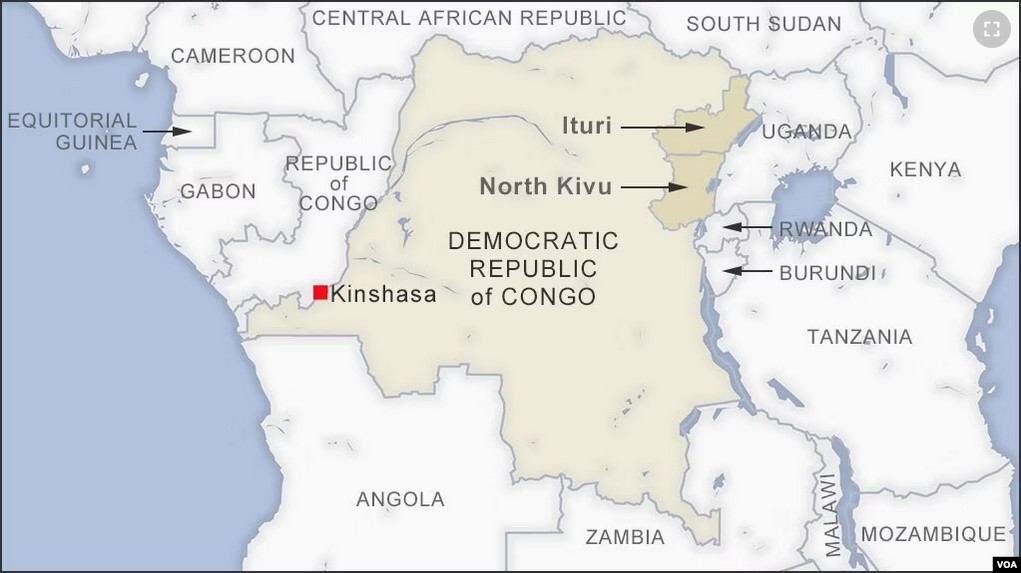
Islamic State Democratic Republic of Congo (ISDRC: the DRC chapter of Islamic State Central Africa Province) continues to consolidate and expand in the DRC’s north-east. This is the same group that on 15 January bombed a church baptism service in North Kivu Province, killing 14 worshippers and wounding around 70 [RLPB 677 (25 Jan 2023)]. Since then ISDRC [formerly known as the Allied Democratic Forces (ADF)] has continued to wreak terror in DRC’s north-east. On Sunday night 22 January, ISDRC terrorists killed 23 civilians in Beni, North Kivu. Before dawn on Sunday 28 January, the group launched simultaneous attacks on three villages in neighbouring Ituri Province (north of North Kivu) leaving more than 20 dead. On Sunday 12 February and Monday 13 February, ISDRC terrorists killed at least 22 civilians and burned homes and medical facilities in two districts of Ituri Province. On Wednesday 15 February they killed five more civilians in Ituri. ISDRC is only one of several militias wreaking havoc in DRC’s north-east where some 6.8 million Congolese have been displaced [UNHCR, Feb 2023] and services – most of which are provided, not by the state but by the Church – have been disrupted. It is a full-blown Christian crisis. Please pray for DRC, for DRC President Felix Tshisekedi (described as a devout Christian), and for DRC’s suffering and imperilled Church.

* GHANA: BAWKU CONFLICT; OPPORTUNITY FOR JIHADISTS

Map showing location of Bawku.
(click on map to enlarge)

A high-risk situation has emerged in Ghana’s far north-east as conflict returns to Bawku. The conflict – between the non-Muslim, mostly-Christian indigenous ethnic Kusasi and the Muslim ethnic Mamprusi who migrated from Togo and established the town in the 18th Century – has ethnic, political and religious dimensions. Power struggles between the Mamprusi (who dominate the urban centre) and the Kusasi (who live on the periphery) are nothing new. However, while the groups used to fight with sticks, now they fight with automatic weapons, making this power struggle far more deadly. What’s more, the consolidation and expansion of jihadist terror groups in the Sahel makes any destabilisation far more dangerous.

After 13 years of peace, conflict erupted in Bawku in November 2021 after a rumour spread that the Mamprusi were ‘planning to install their own regent as chief, in a direct challenge to the current Kusasi ruler’. On 6 February Improvised Explosive Devices (IED) were used in an attempt to blow up a bridge, causing alarm in the security forces as it was the first time an IED had been deployed in Ghana. On 15 February the Mamprusi did install a parallel king/chief in Bawku, an act the government in Accra condemned as ‘illegal and a threat to national security’. Fierce gun battles ensued, and the town is now totally polarised along ethnic and religious lines. The government has announced it will send an additional 5000 troops to Bawku to stem the escalating violence. According to Ghana’s defence minister, Dominic Nitiwul, ‘Unknown elements are sowing seeds of radicalisation in the area …’ Critically, security analysts report that ‘foreigners have infiltrated Bawku and they are being aided by the locals to kill’. These foreigners ‘are the agents of the locals’ who invite them in and give them sanctuary [The Africa Report, 15 Feb]. There is a huge risk that jihadist terror groups based in Burkina Faso and the wider Sahel might exploit the situation to get a foothold in northern Ghana. Please pray.

* INDIA: ARSON IN NARMADAPURAM, MADHYA PRADESH

On Sunday 12 February members of the Evangelical Lutheran Church in Narmadapuram district, in BJP-ruled Madhya Pradesh, arrived for morning prayers only to find that Hindu nationalists had broken into their church and torched the interior. The furniture, carpets, appliances, musical instruments, Bibles and prayer books had been dowsed in flammable liquid and burned. The six-year-old church – which has a seating capacity of 1000 – had only recently been repainted. On 14 February, police arrested three suspected arsonists. While Pastor Mahesh Kumre thanked and praised the police for their prompt action, another Christian leader, Dennis Jonathan lamented that the arsonists will only be charged with ‘hurting religious sentiments’ which, unlike arson, only attracts a minor penalty. The police suspect the accused – who had a list of Christian and Muslim places of worship to target and claimed that they were only defending their religion – are also responsible for two other church arson attacks in Narmadapuram district in January. Christians make up a mere 0.29 percent of Madhya Pradesh’s 72 million population. Please pray for India, for the vulnerable Church in Madhya Pradesh, and that the accused arsonists (three young men in their early 20s) might ‘repent and believe the good news’ (Mark 1:15 NIV).

* NICARAGUA: FORCED EXILE AND IMPRISONMENT
- Church endures most severe crackdown in decades.

On 10 February Bishop Rolando José Álvarez (56) – who was arrested on 19 August 2022 [see RLPB 660 (31 Aug 2022)] – was stripped of his citizenship and sentenced to 26 years in prison after the court deemed him guilty of undermining the government, spreading false information, obstruction of functions and disobedience. A leading Catholic, Bishop Álvarez has been an outspoken critic of President Daniel Ortega. It is the longest sentence given to a political prisoner in years.

One day earlier, on 9 February, the Nicaraguan government forcibly exiled 222 political prisoners, stripping them of their citizenship and putting them on a flight to the USA without informing their families. The CSW press release of 10 February lists the church leaders forcibly exiled: they include numerous Catholics and one Protestant pastor. Bishop Álvarez was supposed to be among them. However, as the US Commission on International Religious Freedom noted in its condemnation of the bishop’s 26-year sentence: ‘Authorities reportedly gave Bishop Álvarez the opportunity to join the exiled prisoners, but he chose to stay in his native country to be with the Catholic community under repression by the Ortega regime.’ Lord have mercy! Please pray.

‘Remember those who are in prison, as though in prison with them, and those who are mistreated, since you also are in the body’ (Hebrews 13:3 ESV).

* PAKISTAN: RELENTLESS PERSECUTION
Sunita Masih after acid attack.
(Morning Star News,
courtesy of family)

KARACHI: On 1 February a Christian girl named Sunita Masih (19) left home to go to work. While at the bus station, a Muslim neighbour, Kamran Allah Bux threw acid over her, burning her face, eyes, arms and legs. Sunita, who belongs to the local Salvation Army church, will be permanently scared, physically and emotionally. Bux (who is married) had long been harassing Sunita, pressuring her to convert to Islam and marry him – advances she repeatedly rejected. Bux has been arrested and police have registered a case against him.

PUNJAB: On 4 February police in Faisalabad finally registered a case against Rana Tayyab, a 60-year-old Muslim man who had, on 15 December, kidnapped a 15-year-old Christian girl named Sitara Arif (also known as Saira). Saira’s father, Arif Gill had spent nearly two months trying in vain to get the police to register a case. On 3 February, when attorney Akmal Bhatti – Gill’s lawyer and chairman of the Minorities Alliance Pakistan – learned of Gill’s plight, he intervened and demanded immediate action from the police. By now Saira will have been forcibly converted to Islam and forcibly married to Tayyab who is rumoured to have taken Saira to Islamabad. Lord have mercy!  

On 6 February a Muslim landowner accused Christian labourer Emmanuel Masih (48) of stealing oranges from his orchard. He, along with five Muslim labourers, then beat Masih to death as he pleaded his innocence. Masih leaves behind a wife and six children; no-one expects to see justice. Lord have mercy! Please pray for the Church in Pakistan.

* SUDAN: ASSASSINATION AND PERSECUTION

On 23 January Ibrahim Kander (or Gebeira) – a pastor with the Sudan Church of Christ – was assassinated in a drive-by shooting by suspected members of Sudan’s State Intelligence. Pastor Ibrahim – a US citizen from Grand Island (a city in Nebraska, USA) – was with his wife, Nafisa Awad Toto, and son, Luis Ibrahim Kander (3) visiting family in the Nuba Mountains when he was shot and killed. While Pastor Ibrahim’s wife and son survived the attack, three of his nephews who were also present did not. Please pray.

On 9 February, Ahmad Adam Mohamad (49) of North Darfur in western Sudan, fled into hiding after his extended Muslim family – who had accused him apostasy – sent Muslim militants to kill him. Mohamad, who has been a follower of Jesus for 10 years now, told Morning Star News: ‘The situation is extremely difficult – I am not safe at all. I urge all the brothers to pray and help me get out from this area to a safer place.’ On Friday 17 February authorities in Sudan’s south-eastern Blue Nile State arrested Yousif Ayoub Hussein Ali for preaching to Muslims at an open-air worship event. Preacher Ali had not violated any Sudanese law and no-one is suggesting that the Muslims were not there of their own free will. Please pray for these our brothers: Ahmad Adam Mohamad and Yousif Ayoub Hussein Ali.

-------------------------------------------------------

Elizabeth Kendal is an international religious liberty analyst and advocate for the persecuted Church. The Religious Liberty Prayer Bulletin (RLPB) is a donor funded ministry. To support this ministry visit www.ElizabethKendal.com

Elizabeth has authored two books: Turn Back the Battle: Isaiah Speaks to Christians Today (Deror Books, Melbourne, Australia, Dec 2012) which offers a Biblical response to persecution and existential threat; and After Saturday Comes Sunday: Understanding the Christian Crisis in the Middle East (Wipf and Stock, Eugene, OR, USA, June 2016). She is also an Adjunct Research Fellow at the Arthur Jeffery Centre for the Study of Islam at Melbourne School of Theology.

For more information see www.ElizabethKendal.com

Monday, February 13, 2023

RLPB 680. Nigerian Elections (3): Buhari's Legacy

Religious Liberty Prayer Bulletin | RLPB 680 | Wed 15 Feb 2023
RLPB is published weekly to facilitate strategic intercessory prayer.

Sign up for the RLPB at www.ElizabethKendal.com  
View RLPB archives at Religious Liberty Prayer Bulletin blog
For bite-size: follow religiouslibertyprayer on Instagram.

Nigeria is at a pivotal point in its history. 'The election in 2023 will determine whether the nation grows as an entity or disintegrates' (Release International). Nigeria has a population of 220 million, around half of whom identify as Christian. The Nigerian Church is one of the world’s leading missionary-sending Churches.

Background:
RLPB 678. Nigerian Elections (1): The Candidates, 1 Feb 2023
RLPB 679. Nigerian Elections (2): Insecurity and the Igbo, 8 Feb 2023

--------------------------------------------------------------------

NIGERIAN ELECTIONS (3): BUHARI’S LEGACY
by Elizabeth Kendal

THE BUHARI AGENDA: On 25 February, when Nigerians vote to elect a new president, it will be the first time in 20 years that Muhammadu Buhari – a Fulani Muslim from the North West – has not been on the ballot. Prior to Nigeria’s return to democracy in 1999, Major-General Buhari did hold power for a little under two years as a military dictator. In December 1983 Maj-Gen Buhari seized power from a civilian government in a military coup, only to lose power in August 1985 to General Ibrahim Babangida (another Northern Muslim) in another military coup. Prior to this, Lieutenant Buhari participated in the infamous 29 July 1966 military coup by which North Muslim officers seized control of the military and the state. A tsunami of genocidal ethno-religious violence subsequently swept across the Muslim North, targeting the Igbo, Nigeria’s most Christian (98 percent), most industrious and most widely dispersed tribe. Traumatised by the ethno-religious cleansing, the Igbo declared independence in their homeland of Biafra, in Nigeria’s South East. This triggered the Nigerian civil war from July 1967 to January 1970 (also known as the Biafra War) in which up to two million ethnic Igbo were killed [see RLPB 679 (8 Feb 2023)]. Having served as president for two four-year terms (the maximum permitted by the constitution) Buhari cannot re-contest. However, there is little doubt that President Buhari spent his eight years in power putting all the pieces in place to ensure the success of his life-long agenda: to Islamise and ‘Fulanise’ Nigeria: i.e. to turn Nigeria into an Islamic State dominated and ruled by the Fulani.

FULANI EXPANSION: Fulani violence comes from two different sources: (1) Nigerian Fulani herdsmen, and (2) foreign, imported Fulani mercenaries. Nigerian Fulani herdsmen routinely conflict with agriculturalists, be they Middle Belt Christians or the North West’s indigenous Hausa. The Nigerian Fulani herdsmen are in turn driven and supported by corrupt Fulani elites in the military and in government who use the herdsmen to effect Fulani territorial expansion. The foreign Fulani – who mostly hail from Niger and Mali [Defense & Foreign Affairs Strategic Policy (D&FA 9,2022)] – were imported to ‘wreak havoc’ and ensure that Buhari won the 2015 and 2019 presidential elections. Lured into Nigeria with promises of land and cash from Fulani state governors, state and federal MPs, and military officials, they remain in Nigeria to this day. According to a Church source (Fides, 16 Jan 2023) these foreign Fulani mercenaries are ‘dedicated to robberies and kidnappings … at the service of those who pay them to commit massacres and murders.’ They invade Christian villages riding on motorbikes, wearing bulletproof vests and firing automatic weapons; perpetrating massacres, displacing thousands and unleashing terror across the Middle Belt with impunity.

MILITARY TIES WITH IRAN: Since 2016, the Buhari government has been quietly sending Nigerian Fulani for military training in Iran. According to D&FA (9,2022) at least 600 of these Nigerian Fulani ‘are now back in Nigeria and are within the overall Fulani militia movement’. Further to this, the Buhari government recently deepened its official ties with Iran. On 24 August 2022 Nigeria’s Minister of Defence, Maj-Gen Bashir Magashi (rtd), hosted Iranian Ambassador to Nigeria, Mohammed Alibak, to promote Nigeria’s Minister of Defence, Maj-Gen Bashir Magashi (rtd) meets with Iranian Ambassador, Mohammed Alibak, to promote military ties, 24 Aug 2022.military ties between the Armed Forces of the two countries. On 27 August 2022 Nigeria and Iran signed a Memorandum of Understanding to expand energy co-operation and military ties. Muslims unite and divide along several axes, not just the sectarian Sunni-Shi’ite Axis. While Nigeria’s ruling Muslims are Sunni, and Iran’s ruling Islamic clerics are Shi’ite, both governments share a desire to defeat the Islamic State terror group (which is anti-government, trans-nationalist and virulently anti-Shi’ite). Muslim groups and governments also unite or divide over whether they are pro- or anti-Muslim Brotherhood and whether they are allied to or actively resisting the United States and Israel. Thus the Iran (Persian-Shi’ite)-led Axis of Resistance includes numerous ‘resistance’ groups such as Shi’ite Arab Hezbollah, Sunni Arab Hamas and Sunni trans-nationalist al-Qaeda. All Christians should be deeply concerned by this development.

Jihadists pose with Anti-Aircraft Artillery (AAA)
possibly purchased from corrupt Nigerian military.
(Global Sentinel, Sept 2021)

TURKEY AND THE JIHAD: Meanwhile, Turkey – specifically Turkey’s intelligence agency (MIT) – is deeply involved in Nigeria’s jihadist movement. D&FA has been warning since at least December 2014 that Turkey has been supporting and selling weapons to Boko Haram. In November 2019, Gatestone Institute reported that Turkey was supplying Boko Haram with sophisticated weapons. Jihadists also work with criminals to import weapons over Nigeria’s porous borders. Furthermore, in May 2019, Religious Liberty Monitoring warned that corrupt elites in the Nigerian government and military were prolonging the conflict with Boko Haram for personal gain as they personally profited from ‘Armsgate’: corruption in military procurement. Questions remain as to how jihadists are obtaining weapons from the Nigerian military, including Anti-Airforce Artillery which jihadists have used to down jets from the sky and blow away Nigerian infantry on the ground. Now that Boko Haram has split, split again, and dispersed across the nation [RLPB 562 (12 Aug 2020)] fears abound that the security situation is beyond the capabilities of the overstretched, under resourced and critically demoralised Nigerian military. To both advance jihad and win favour with the Nigerian government, Turkey is now selling armed drones to both sides (the jihadists and the Nigerian military). If ethnic-religious war erupts, Christian vulnerability will be beyond comprehension.


PLEASE PRAY THAT OUR SOVEREIGN GOD WILL

* intervene in Nigeria to frustrate the wicked plans of wicked people who pursue power and wealth at the cost of peace, the interests of the nation and a multitude of human lives (see Psalm 146).

* intervene in Nigeria to protect, sustain and – above all – sanctify his precious Church in Nigeria. May no evil plans or weapons fashioned against her succeed; and may all God’s purposes for her be fulfilled.

‘The Lord brings the counsel of the nations to nothing; he frustrates the plans of the peoples. The counsel of the Lord stands forever, the plans of his heart to all generations… Let your steadfast love, O Lord, be upon us, even as we hope in you.’ (from Psalm 33:10-22).

* expand and empower all Christian prayer for and mission to Nigeria’s Muslims. May the Holy Spirit call and compel many more Nigerian Christians into prayer and mission, born of love, for Nigeria’s Northern Hausa and Fulani. May the Holy Spirit open the eyes of the Fulani, that they might discern good from evil, truth from lies and recognise when they are being used/exploited by corrupt Fulani elites in pursuit of power and wealth. May the Holy Spirit – ‘the Lord, the giver of life’ (Nicaean Creed) – open Muslim hearts to receive the Gospel.


SUMMARY FOR BULLETINS UNABLE TO RUN THE WHOLE ARTICLE
-----------------------------------------
NIGERIAN ELECTIONS (3): BUHARI’S LEGACY


Nigeria’s President Muhammadu Buhari (a Fulani Islamist from Nigeria’s North West) has long wanted to Islamise and ‘Fulanise’ Nigeria: that is, to turn Nigeria into an Islamic State ruled by the Fulani. On 25 February, when Nigerians vote for a new president, Buhari will not be on the ballot as he has served the maximum two terms. There is little doubt however, that Buhari spent his eight years in power (2015-2023) putting all the pieces in place to ensure his life-long agenda succeeds. For eight years, corrupt Fulani elites in the government and military have fostered insecurity, facilitated the expansion of Nigerian Fulani herdsmen, imported foreign Fulani mercenaries, supported Islamic jihadists, and deepened the military’s ties with Turkey and Iran. If ethnic-religious war erupts, Christian vulnerability will be beyond comprehension. Please pray.
------------------------------------------

Elizabeth Kendal is an international religious liberty analyst and advocate for the persecuted Church. To support this ministry visit www.ElizabethKendal.com

Elizabeth has authored two books: Turn Back the Battle: Isaiah Speaks to Christians Today (Deror Books, Melbourne, Australia, Dec 2012) which offers a Biblical response to persecution and existential threat; and After Saturday Comes Sunday: Understanding the Christian Crisis in the Middle East (Wipf and Stock, Eugene, OR, USA, June 2016). She is also an Adjunct Research Fellow at the Arthur Jeffery Centre for the Study of Islam at Melbourne School of Theology.

For more information visit: www.ElizabethKendal.com 

Tuesday, February 7, 2023

RLPB 679. Nigerian Elections (2): Insecurity and the Igbo

Religious Liberty Prayer Bulletin | RLPB 679 | Wed 08 Feb 2023
RLPB is published weekly to facilitate strategic intercessory prayer.

Sign up for the RLPB at www.ElizabethKendal.com  
View RLPB archives at Religious Liberty Prayer Bulletin blog.
For bite-size: follow religiouslibertyprayer on Instagram.

Nigeria is at a pivotal point in its history. The 2023 elections will determine whether the nation grows as an entity or disintegrates into poverty, ethnic-religious conflict, even full-blown civil war. Nigeria has a population of 220 million, around half of whom identify as Christian. The Nigerian Church is one of the world’s leading missionary-sending Churches.

Background:
RLPB 678. Nigerian Elections (1): The Candidates, 1 Feb 2023

------------------------------------------------------

RLPB 679. NIGERIAN ELECTIONS (2): INSECURITY AND THE IGBO
by Elizabeth Kendal

Nigerians will go to the polls on 25 February to elect a new president amidst gross insecurity. Having established bases and secured territory, Islamic jihadist groups – in particular the ascendant Islamic State West Africa Province (ISWAP) – spent 2022 expanding into the South and encircling the Federal Capital, Abuja. In May 2022 anti-blasphemy killings and pogroms erupted across the North [see RLPB 646 (25 May 2022)], indicating the extent of radicalisation there. Meanwhile, in the volatile, mixed Middle Belt, Fulani militants continue their campaign of ethnic-religious cleansing of Christians. Massacres, mass abductions and assassinations are perpetrated nationwide with impunity. Add to this, high levels of election-related violence are now being recorded, against candidates and polling stations [see Nigeria Election Violence Tracker]. Analysts warn that high levels of violence and insecurity could cause the elections to be fatally compromised.

The Nextier poll of 27 January has Labour’s Peter Obi – an ethnic Igbo Christian from the long-marginalised South East – leading the race with 37 percent of the vote. Obi is followed by the PDP’s Atiku Abubakar (a Fulani Muslim from the North East) with 27 percent, the APC’s Bola Tinubu (a Yoruba Muslim from the South West) with 24 percent, and the NNPP’s Rabi’u Kwankwaso (a Fulani Muslim from the North West) with six percent. The poll concludes: ‘Peter Obi has the highest net favourability amongst the top presidential candidates while Labour Party has the highest net favourability amongst the top political parties.’ Impoverished and disillusioned, Nigerians – particularly youths – are yearning for radical change. To be elected in the first round, a candidate must win a majority of the vote and more than 25 percent of the votes in at least 24 of Nigeria’s 36 states. The Nextier poll showed Obi could win 25 percent in 23 states. It seems Nigeria is headed for its first ever a runoff election: a race between Peter Obi and either Atiku Abubakar or Bola Tinubu.

Nextier poll 27 January 2023

The significance and risk of Peter Obi’s rise cannot be overstated. Nigeria has not had an Igbo president since Nnamdi Azikiwe, Nigeria’s first president, who served from October 1963 until he was ousted in an Igbo-led military coup in January 1966. That coup was followed on 29 July 1966 by a ‘revenge’/counter coup by Northern Hausa-Fulani Muslim soldiers who mutinied and took control of the military and the state. A tsunami of genocidal anti-Igbo pogroms swept across the North, incited by Islamic clerics. At that time an estimated 1.3 million Igbo – Nigeria’s most Christian (98 percent), most industrious and most widely dispersed tribe – lived and worked outside the South East. Of the 800,000 Igbo in the North, more 30,000 were killed. Around one million Igbo refugees poured into the South East (the Igbo homeland), triggering calls for a separate state. On 30 May 1967 the ‘Republic of Biafra’ declared independence, triggering the Nigerian Civil War, also known as the Biafra War. Between 6 July 1967 and 15 January 1970, the war claimed the lives of some 100,000 military personnel, and up to two million predominantly Igbo Biafran civilians, hundreds of thousands of whom were deliberately starved to death in a junta-imposed food blockade. The region’s subsequent political marginalisation and neglect has only served to compound Igbo victim-hood and fuel a separatist movement known as the Indigenous People of Biafra (IPOB). Many believe that the election of Igbo president would signal that Nigeria has truly turned a corner towards healing and unity. That hope, however, is tempered by the fear that Northern Muslims will not let that happen, and history might repeat itself.

Analysts at Crisis Watch have identified several states where the risk of electoral violence is particularly high. It is widely feared that in Lagos (South West) pro-APC thugs will repeat their violence of 2019 and attack polling stations in opposition strongholds and ethnic Igbo residential areas so as to depress voter turnout there. According to The Africa Report (25 Jan), Tinubu’s ‘foot soldiers have been deployed across the state to ensure he wins by a landslide’. In Muslim Kano (North West), three of the state’s most influential former governors are pulling in three different directions. Kwankwaso (a pro-Sharia, Kano-based, Northern Fulani) is running as the candidate for the NNPP. Meanwhile, two other former governors are supporting the APC’s Tinubu (in support of the APC’s Muslim-Muslim ticket), and the PDP’s Atiku (in support of a pro-business Northern Fulani). The risk of violence is high, both between Muslims and against minority Christians, especially Igbo settlers/traders.

In volatile Kaduna (North Central / Middle Belt) – an ethno-religious fault-line state already in the grip of a full-blown Christian Crisis – the risk of catastrophic Muslim violence against Christian indigenes and Igbo settlers/traders is extreme. Muslims are furious that the Labour Party has chosen as its candidate for Kaduna Governor, Jonathon Asake, who hails from predominantly Christian Southern Kaduna and was, until recently, president of the Southern Kaduna Peoples Union. [Gubernatorial and state legislative elections are slated for 11 March.] Asake has spoken out against the ‘silent genocide [that] is going on against Christian communities in Southern Kaduna and the whole of Nigeria’s Middle Belt … by people who are well-protected, well-armed and who get away with it’. Despite all his effort to assure Kaduna’s Muslims he would govern with fairness for all, no amount of appeasement will satisfy Muslim fundamentalists who hold to the Quranic injunction not to take Jews or Christians as guardians /leaders (see https://quran.com/5:51).


PLEASE PRAY THAT OUR SOVEREIGN GOD WILL

* protect his precious Church in all areas vulnerable to Islamic terror, Fulani expansion and election violence.

* raise up voices for peace and righteousness, that Nigerians may not be lured or incited into violence to the detriment of community and for the benefit of political and religious megalomaniacs. May a spirit of peace, and a desire for unity and neighbourliness take hold; may violence be rejected, for the sake of Nigeria, all Nigerians and Nigeria’s mission-focused but gravely imperilled Church.

* protect Peter Obi and all who identify with his campaign for a New Nigeria free of corruption and conflict. May all those who speak for justice, integrity, freedom and peace – be they pastors, journalists, academics, community leaders, neighbours – know the gracious protection and blessing of God. May the witness and example of Christians be powerful and effective.

Blessed is he whose help is the God of Jacob, whose hope is in the Lord his God… The Lord lifts up those who are bowed down; the Lord loves the righteous… but the way of the wicked he brings to ruin (excerpts, Psalm 146).


SUMMARY FOR BULLETINS UNABLE TO RUN THE WHOLE ARTICLE
------------------------------------------
NIGERIAN ELECTIONS (2): INSECURITY AND THE IGBO


On 25 February Nigerians will vote for a new president amidst gross insecurity. High levels of violence and insecurity could cause the elections to be fatally compromised. Labour’s Peter Obi – an ethnic Igbo from the South East and the only Christian among the four main candidates – is leading in the polls but unlikely to win in the first round, meaning Nigeria is heading for its first ever presidential runoff. Ethnic-religious tensions are soaring. Analysts anticipate that thugs in the South West and fundamentalist Muslims across the North will attack polling stations in opposition strongholds and Igbo residential areas to depress voter turnout there. Lagos, Kano and Kaduna have been identified as states where the risk of electoral violence, including to Christian indigenes and ethnic Igbo settlers/traders, is extreme. Please pray.

------------------------------------------

 Elizabeth Kendal is an international religious liberty analyst and advocate for the persecuted Church. To support this ministry visit www.ElizabethKendal.com.

Elizabeth has authored two books: Turn Back the Battle: Isaiah Speaks to Christians Today (Deror Books, Melbourne, Australia, Dec 2012) which offers a Biblical response to persecution and existential threat; and After Saturday Comes Sunday: Understanding the Christian Crisis in the Middle East (Wipf and Stock, Eugene, OR, USA, June 2016). She is also an Adjunct Research Fellow at the Arthur Jeffery Centre for the Study of Islam at Melbourne School of Theology.

For more information visit: www.ElizabethKendal.com

Wednesday, February 1, 2023

RLPB 678. Nigerian Elections (1): The Candidates

Religious Liberty Prayer Bulletin | RLPB 678 | Wed 01 Feb 2023
RLPB is published weekly to facilitate strategic intercessory prayer.

Sign up for the RLPB at www.ElizabethKendal.com 
View RLPB archives at Religious Liberty Prayer Bulletin blog.
For bite-size: follow religiouslibertyprayer on Instagram.

NIGERIAN ELECTIONS
by Elizabeth Kendal

As promised in RLPB 676 (20 Dec 2022), ‘The RLPB will start 2023 with a major focus on Nigeria’s presidential election, slated for 25 February.’ At this stage (i.e. unless I am led otherwise) these RLPBs will cover: (1) the candidates, (2) Nigeria’s gross insecurity and (3) Buhari’s Legacy. On 22 February, the monthly Update will be published as usual.

If there is too much information here for your needs or liking, don’t worry – just leave the detail to those who do want and need it and skip to the summary and prayer points at the end. Prayer – not an understanding of all the details and dynamics – is what is most needed. Please pray!

--------------------------------------

INTRODUCTION: WHY THIS ELECTION IS SO IMPORTANT

In its 9, 2022 issue of Defense & Foreign Affairs Strategic Policy, the International Strategic Studies Association warned: ‘Nigeria is at a pivotal point in its history… A change in the Federal Government is inevitable [as President Buhari has served two terms and cannot recontest]. In its 1, 2023 issue, D&FA reiterates: ‘Nigeria is at a tipping point, beyond which it will either coalesce as a “modern nation-state” and move toward an India-style economic take-off, or decline into long-term crisis which could stimulate an increase in the drive for secession by some ethnically- or linguistically/culturally-cohesive regions.’ Release International’s partner in Nigeria agrees (28 Dec): ‘Every indication suggests Nigeria is at a pivotal point in its history. The election in 2023 will determine whether the nation grows as an entity or disintegrates.’ Disintegration would trigger a Christian Crisis of monumental, even genocidal proportions for millions of Nigerian Christians, multitudes of whom are already suffering extreme levels of poverty, insecurity, criminality, religious persecution and Islamic jihad.

Nigeria has a population of 220 million, around half of whom identify as Christian. The Nigerian Church is one of the world’s leading missionary-sending Churches. The Nigerian Evangelical Missions Association (NEMA) is a national network with 150 member agencies and 15,000 missionaries serving in 197 countries. The goal of NEMA’s ‘Vision 5015’ is to train and send 50,000 Nigerians within 15 years, as gospel bearers to the Core North of Nigeria, the Sahel, North Africa, the Arabian Peninsula and back to Jerusalem. This is a spiritual battle! (Ephesians 6:12)

--------------------------------------

NIGERIAN ELECTIONS (1): THE CANDIDATES

Nigerian politics has long been a two-horse race between the People’s Democratic Party (PDP, right of centre) and the opposition (left of centre, currently the All Progressives Congress (APC)). ‘To be elected in the first round, a [presidential] candidate must receive a majority of the vote and more than 25 percent of the vote in at least 24 of the 36 states. Failing that, a second round would be held between the leader and the next candidate, with the winner needing a plurality of votes in the highest number of states’ [Defense and Foreign Affairs Strategic Policy (D&FA) 1, 2023]. This ensures that the winning candidate has a degree of national consensus, something small regional parties normally cannot secure. 

----------------------------------------

CORRECTION: the winning candidate does NOT need to win a majority of the vote!

According to Nigeria's 1999 Constitution:
Article 134
(2) A candidate for an election to the office of President shall be deemed to have been duly elected where, there being more than two candidates for the election -
(a) he has the highest number of votes cast at the election;
and
(b) he has not less than one-quarter of the votes cast at the election each of at least two-thirds of all the States in the Federation and the Federal Capital Territory, Abuja.

---------------------------------------

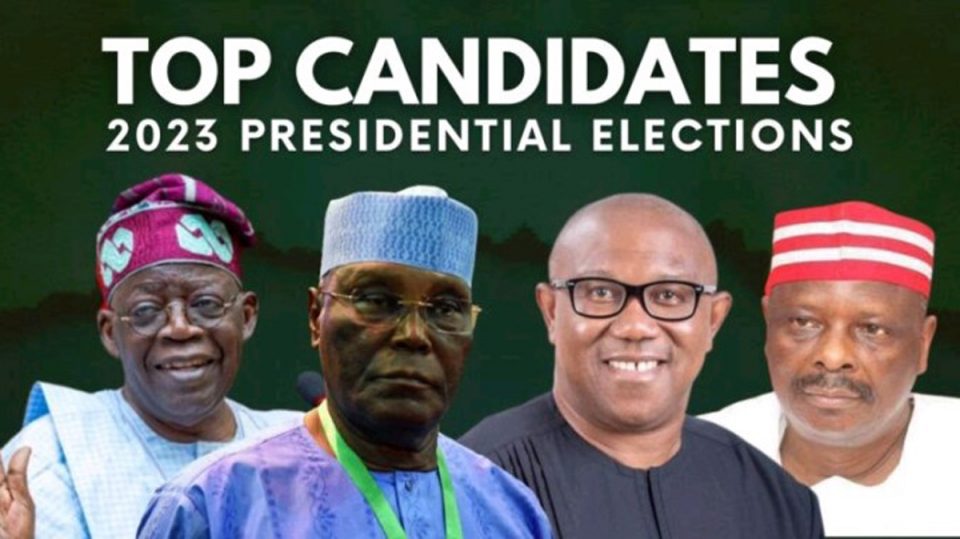
Along with this, there has always been an unwritten rule that, in fairness, power should alternate around the regions, and particularly between North and South. Another unwritten rule has been that political parties should alternate between Muslim and Christian presidential candidates on their tickets. This year however, the two major parties rejected the unwritten rules for political gain, in a move that has backfired and changed the dynamic of the elections entirely. This year, four candidates are in with a chance. Critically, they come from the four corners of Nigeria – North West, North East, South East and South West; and from the three leading tribes – Fulani (North), Yoruba (SW) and Igbo (SE). Three are Muslim; one is Christian.

left to right:
Tinubu (APC), Atiku (PDP), Obi (Labour) and Kwankwaso (NNPP)

While the ruling All Progressive Congress (APC) party of incumbent president Muhammadu Buhari (a northern Muslim) did chose a southerner as its candidate, it controversially chose a Southern Muslim – the Yoruba, former Governor of Lagos, Bola Tinubu (known as ‘the Godfather of Lagos’). Even more controversially, Tinubu then chose a Northern Muslim as his running mate – Kashim Shettima, the former Governor of Borno State – leaving the APC with a Muslim-Muslim ticket. This was a political decision as the predominantly Muslim North generally has a higher voter turnout than the predominantly Christian South and the APC is eager to secure President Buhari’s northern vote bank. While Buhari’s vote bank will doubtless be split among the three Muslim candidates, some fundamentalists – specifically Muslim clerics in Kano (the state that consistently has the highest voter turnout) – have endorsed Tinubu on the basis of the APC’s Muslim-Muslim ticket, calling it ‘a call to jihad’ that had ‘defined the supremacy of Islam’. The move has left Christians feeling totally betrayed.

Like the APC, the People’s Democratic Party (PDP) is also chasing Buhari’s northern vote bank. Consequently, the PDP similarly ignored convention and retained a Muslim as its presidential candidate: Atiku Abubakar, a Fulani Muslim and former Governor of Adamawa State in Nigeria’s North East. Atiku was the PDP candidate in 2019 when he lost to Muhammadu Buhari in what was doubtless a fraudulent election. Peter Obi – an Igbo Christian, former Governor of Anambra State in Nigeria’s South East – had been Atiku’s running mate at the time and expected the PDP would promote him as its presidential candidate for 2023. When that did not occur, Obi resigned in protest and will run instead as the presidential candidate for the Labour Party (a minor party which currently holds 2 of 360 seats in the House of Representatives; 1 of 109 seats in the Senate; and no state governorships or seats in State Houses of Assembly). Not only did the PDP chose to retain Atiku, but according to The Africa Report (12 August 2022), ‘all key positions in the PDP are occupied by northerners, which insiders say was done in order to boost the party’s chances of victory in the north… Atiku’s decision to delete his tweets condemning the blasphemy killings in the north in order not to anger Muslim hardliners in the regions also revealed his hand.’ While Atiku has chosen a Christian as his running mate – Ifeanyi Okowa, the Governor of Delta State in Nigeria’s South-East – the PDP’s decision to retain a Northern Muslim as its presidential candidate triggered an internal party war and left Christians feeling totally betrayed.

As the presidential candidate for Labour, Peter Obi has been taking the country by storm. Running on an anti-establishment, pro-education platform, Obi has been winning the hearts and minds of youths across the nation, including across the North. His running mate – Yusuf Datti Baba-Ahmed – is a former Senator from Kaduna who resigned from the APC in 2017 accusing ‘Buhari’s government’ of being ‘incompetent and corrupt’. At recent rallies in the North East states of Borno and Gombe, Obi urged the electorate to vote ‘for competence and accountability instead of voting based on religion, ethnicity or tribe’. ‘When they say vote for them because they are from the North, tell them we are hungry, tell them we have no jobs, we have no schools, you are not secured… Don’t vote for them because of religion. Don’t vote because it is anybody’s turn. It is your turn to take back Nigeria… We want to build a new Nigeria. You voted for the umbrella [the logo of the PDP], which leaked and left you suffering; you voted for the broom [the logo of the APC], they swept you into poverty. Now is the time to vote for human beings to bring about a new Nigeria. It’s time to vote for mama, papa, and children.’ [The logo of the Labour party is a wheel with a man, a woman and a child engraved in the centre.]

Lastly, the presidential candidate for the New Nigeria Peoples Party (NNPP), Rabi’u Kwankwaso, was the Governor of Kano when that state adopted Sharia Law in June 2000. Centred on Kano in Nigeria’s North West, the NNPP is – like the PDP and APC – chasing Buhari’s Fulani Islamist vote bank. In the hope of winning over some Christians and southerners, the pro-Sharia Kwankwaso has adopted Buhari’s strategy and chosen as his running mate a Pentecostal mega-church pastor: the obscenely wealthy, gospel singing tele-evangelist and prosperity-preaching ‘bishop’ Isaac Idahosa, of the Illumination Assembly in Lagos [Idahosa's Instagram].

According to Defense & Foreign Affairs Strategic Policy (1, 2023) (the magazine of the International Strategic Studies Association), the PDP’s pro-business Atiku Abubakar is the best candidate to unite Nigerians, and the only candidate who ‘has offered a truly pan-Nigerian approach to governance along with a concrete set of specific proposals as to how he would streamline government, reduce corruption, improve security, and stimulate investment.’ Meanwhile, multiple polls have Labour’s Peter Obi in the lead, much to the delight of his mostly-youthful supporters who identify as ‘Obidients’. The question remains however: would Buhari’s vote bank of Fulani Islamist Muslims – including many military officials who have benefited from the government’s corruption – accept an Obi win? Could an Obi win – or even the threat of an Obi win – trigger fresh pogroms against the Igbo, Nigeria’s most Christian (98.8 percent), most industrious and most widely dispersed tribe? More on that next week.

PLEASE PRAY:

Dear God our Father,
we do not presume to know what you have planned for the nation of Nigeria in the short or long term. We only know that you have a plan for your beloved Nigerian Church – a Church committed to your Great Commission (for global mission; Matthew 28:18-20).
Nor do we presume to know what is best for Nigeria or for your Church at this particular time in history (His-Story). We only know that you know what is best and that you alone have the power to bring it to pass.
Consequently, Father, we humbly place the Nigerian elections in your almighty and loving hands; help us to trust you with the results. We humbly lift the people of Nigeria before you, and plead for your grace and mercy. We humbly beseech you to protect, sustain and bless your beloved Church in Nigeria that she might fulfil all you have planned for her in your generous sovereign grace and great plan of redemption.
May evil be restrained and may candidates and commentators refrain from inflammatory rhetoric and incitement to ethnic or religious violence. May peace, freedom, justice, truth and righteousness prevail.
Lord have mercy!
AMEN


SUMMARY FOR BULLETINS UNABLE TO RUN THE WHOLE ARTICLE
------------------------------------------
NIGERIAN ELECTIONS: THE CANDIDATES


On 25 February, Nigerians will elect a new president amidst gross insecurity, escalating Islamic terror and soaring ethnic and religious tensions. Normally a two-horse race, this year is different with four leading candidates hailing from the four corners of Nigeria (NW, NE, SE, SW), and from its three leading tribes (Fulani, Yoruba, Igbo). Three are Muslim, one is Christian. Many fear the presidential election could cause the country to blow apart. Should that happen, it would trigger a Christian Crisis of monumental, even genocidal proportions, especially for Nigeria’s long-suffering Christians in the volatile mixed Middle Belt and predominately Muslim North. Nigeria has a population of 220 million, around half of whom identify as Christian. The Nigerian Church is one of the world’s leading missionary-sending Churches. This is a spiritual battle! Please pray.

------------------------------------------

Elizabeth Kendal is an international religious liberty analyst and advocate for the persecuted Church. To support this ministry visit www.ElizabethKendal.com.

Elizabeth has authored two books: Turn Back the Battle: Isaiah Speaks to Christians Today (Deror Books, Melbourne, Australia, Dec 2012) which offers a Biblical response to persecution and existential threat; and After Saturday Comes Sunday: Understanding the Christian Crisis in the Middle East (Wipf and Stock, Eugene, OR, USA, June 2016). She is also an Adjunct Research Fellow at the Arthur Jeffery Centre for the Study of Islam at Melbourne School of Theology.

For more information visit: www.ElizabethKendal.com